
Clark County Voter Registration Lookup
The Clark County Election Department provides Registered Voter Services for a voter checking their own record. It is an identity-gated service, not a public name-only search. A successful login can show registration information, voting history, elected representatives, mail-ballot status, and details tied to an election. Logged-in forms also support name, address, and party changes, cancellation, and confidentiality requests.
Enter the information as it appears on the current voter record. A recent move, changed surname, or mismatch in the residence element can prevent login. The fields distinguish this personal voter registration lookup from the public data files described later.
| Lookup field | Input | Required | How it is used |
|---|---|---|---|
| Last Name | Text | Yes | Registered surname |
| First Name | Text | Yes | Registered given name |
| Date of Birth | Date or text | Yes | Identity validation |
| House Number or Address Element | Text | Service dependent | Registered residence validation |
| Submit or Login | Button | Yes | Opens the personal service |
| Clear or Reset | Button | No | Clears displayed fields |
The county's Registered Voter Services page shows the official route before login.
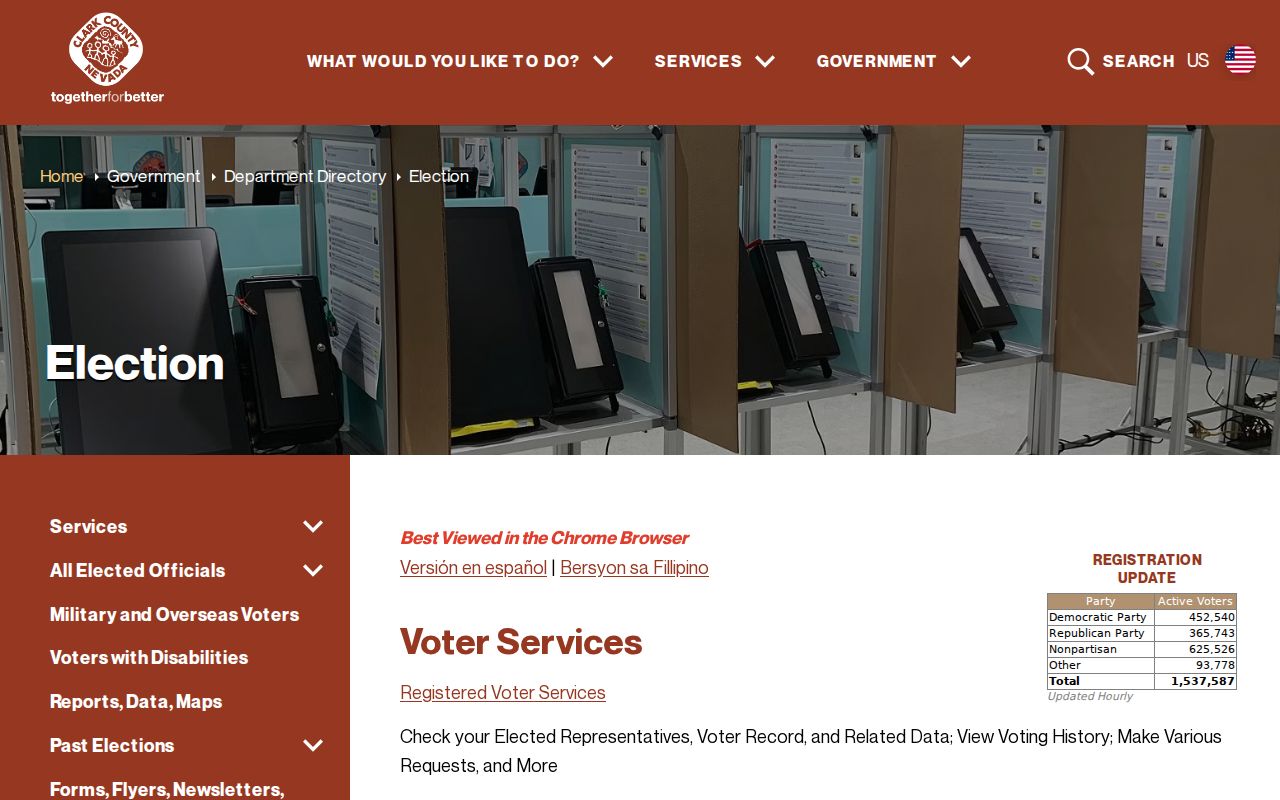
The screenshot confirms that personal record tools sit with Clark County Elections rather than in a broad public people index.
Clark County Voter Records Help
When the online identity check fails, contact Elections instead of trying variations that belong to another person. Registration staff can help resolve a mismatch and explain which form fits a correction. The office is at 965 Trade Drive, North Las Vegas, NV 89030-7802. Call (702) 455-VOTE (8683) or email ELinfo@ClarkCountyNV.gov. Published hours are Monday through Thursday, 7:30 a.m. to 5:30 p.m.; the office is closed Friday.
The same office is the direct channel for a name, address, or party update, a registration cancellation, a confidentiality request, and questions about a data product. The county voter registration service page routes voters to these options. This channel matters because a public download cannot correct the underlying voter record, and the general county records portal is not the best route for a voter-account issue.
Note: Use Elections staff for a personal registration mismatch; use the published-data route when the goal is a lawful voter-list dataset.
Nevada Voter Records Boundaries
Nevada law draws a line between inspectable registration data and identifiers that remain closed. NRS 293.503 generally makes county registration records available for inspection, while protecting the place where a person registered. NRS 293.557 governs published lists. The specific disclosure limits in NRS Chapter 293 control over the general open-record presumption. The broader request process belongs with Clark County public records, while election statutes control this record set.
NRS 293.558 requires disclosure of the voter identification number, but bars release of a Social Security number, driver's license or state identification number, and the email address supplied for the election process. A voter may ask the county to withhold a home address and telephone number. Preregistration data also stays confidential until it converts into a registration.
Confidential voter data. Nevada withholds Social Security and license identifiers, election email addresses, preregistration data, and protected-voter details under NRS 293.558 and NRS 293.900 through 293.912.
These limits explain why a personal login can show more to the voter than a public Clark County voter records file shows to a downloader. Redaction is part of the system, not evidence that the public file is incomplete.
Clark County Voter Record Fields
A Clark County voter row can connect a registered name to a district, precinct, status, party, and a limited history of participation. The official file layout uses codes, so the data dictionary should remain beside any downloaded file. Address fields distinguish the residence from a mailing address. District fields identify congressional, legislative, commission, education, regent, school, city, ward, and township assignments.
| Registered identity | First, middle, and last names; suffix; sex; birth year; registration number |
|---|---|
| Addresses | Residence components and separate mailing fields, unless protected |
| Registration | Active or inactive status, party code, activity date, registration date, language preference |
| Political geography | Precinct and assigned congressional, state, county, school, city, and township districts |
| Election history | Up to 20 election and vote-method pairs, newest first |
| Privacy markers | Confidential flag and other administrative indicators |
Status code A means active and I means inactive. Party codes include DEM, REP, NP, OTH, and minor-party codes. Vote methods include P for Election Day, M for mail, E for early voting, F for a federal write-in, and Z for provisional voting. A confidential flag causes protected fields to be omitted.
Clark County Voting History Limits
A participation entry shows that a voter was recorded as voting in an election. It does not show a choice, candidate, or ballot response. Nevada's secret ballot remains secret. The public file may pair an election with a method code, such as mail or early voting, but that code describes how participation occurred.
This distinction prevents a common mistake when reading voter registration records. A sequence of election fields can help confirm that the row remains active over time, yet it cannot reveal political preferences beyond the party field supplied at registration. Even party affiliation is not proof of a vote for any candidate.
Participation is not a ballot. Clark County voter history lists elections in which a person took part, never the selections made on that person's ballot.
Use the history as limited administrative data. Do not present it as a record of how anyone voted. That false inference can distort family research, civic analysis, and any attempt to distinguish two people with the same name.
Download Clark County Voter Lists
The county publishes standard voter-list data files by district, plus walking lists by precinct and separate inactive and canceled datasets. Related downloads can include early-voting turnout and mail-ballot request or status data. These are the right starting point for a broad voter-roll study because Registered Voter Services is designed for one voter at a time.
Read the file-layout document before importing the data. The downloads use ASCII comma-delimited files, and raw columns include short names and codes that are easy to misread. Keep leading zeros, preserve text-formatted precinct values, and apply the listed code meanings instead of guessing.
The official download page displays the available Clark County voter files and maintenance notes.
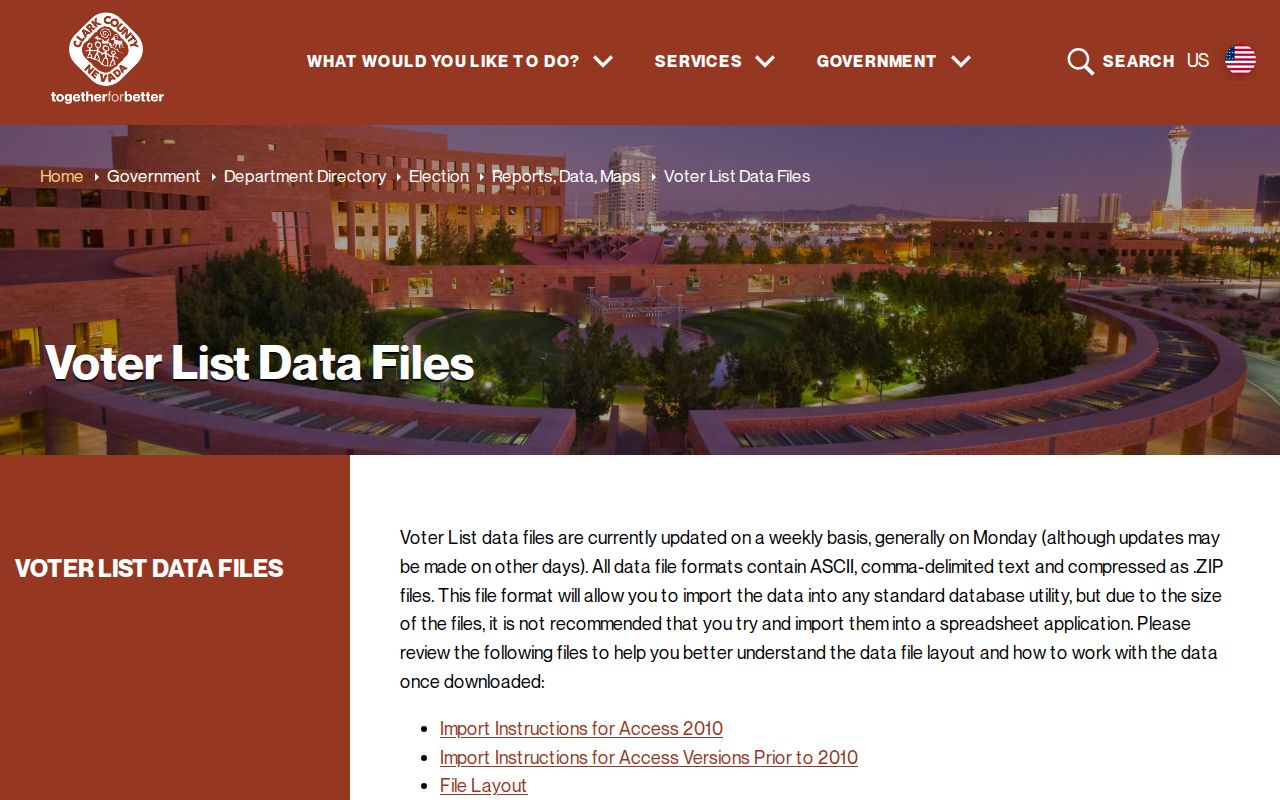
The page separates standard public files from a personal voter login and gives researchers the county's current distribution point.
Why Clark County Voters Go Inactive
Inactive status is not the same as immediate cancellation. The county explains that a nonvalid address or a returned biennial voter card can move a record to inactive status. An eligible inactive voter may still vote, but election mail stops. The inactive-voter data page is updated weekly and explains the maintenance process.
On March 10, 2026, Clark County reported that 104,945 voter records had moved to inactive status after address-maintenance work. Under the National Voter Registration Act and NRS 293.530, an inactive record can be canceled if the voter does not vote through two consecutive federal elections. The county separately reported 138,682 cancellations after the November 5, 2024 general election under that rule.
These figures are snapshots of voter-roll maintenance, not proof that every named voter became ineligible on the report date. Check the current personal service for an individual's present status and contact Elections when a correction is needed.
Note: Published inactive and canceled files can change after registration activity, correction, or later list maintenance.
Protect Clark County Voter Addresses
A Nevada voter can separately ask for address and telephone confidentiality under NRS 293.558. Clark County's logged-in services include a confidentiality-request route. The protected-person provisions in NRS 293.900 through 293.912 add safeguards for covered voters. As of publication, the version of NRS 293.908 effective July 1, 2026 applies.
The Nevada Confidential Address Program, governed by NRS 217.462 through 217.471, offers a fictitious mailing address and mail forwarding to qualifying victims of domestic violence, sexual assault, stalking, or human trafficking. NRS 293.5002 allows a program participant to register and vote without exposing the confidential residence. This is different from a routine request to withhold an address or phone number.
Protected fields may leave an uneven public trace. A name, voter identification number, status, or district entry may remain while a residence or phone field is removed. Anyone using the voter rolls must honor that boundary and must not try to reconstruct a protected address from other data.
Request Nevada Voter Files
Standard Clark County files can be downloaded at no charge. For a custom geography, field set, format, or paper product, request the voter file from the Clark County Election Department. The county's older product guide lists possible formats and historical prices, but the current charge and any required use certification must be confirmed before ordering.
- Choose the report or list, such as countywide data, a district file, a precinct walking list, or a custom extract.
- State the geography, requested fields, output format, and delivery details. Ask Elections which confidentiality and use terms apply.
- Confirm the current price before payment. Older materials list Access, Excel, ASCII comma-delimited, fixed-block text, printed, and PDF options.
- Keep the layout documentation with the delivered file and exclude confidential fields from any later use.
The historical guide listed printed custom reports at one cent per record with a $5 minimum, custom PDF at $30, standard data at one cent per name capped at $100 plus $30 for download or media, and custom data at $130 plus programming time. Those figures require confirmation because the guide is older.
Voter data may not be used to harass, intimidate, stalk, or unlawfully target a protected voter. Nevada stalking and harassment law includes NRS 200.575. Contact Clark County Elections or the Nevada Secretary of State about suspected election-data misuse.
Historic Clark County Voter Records
Clark County has digitized historical election documentation spanning 1910 through 1996, including a county announcement from 1909. These materials add context to the modern voter registration system, but they should not be treated as a complete name-by-name roll for every election. The surviving name-level years were not verified in an official archive catalog.
Voter rosters and poll books have a minimum retention period of 22 months after an election under the state and local schedule. That rule helps explain why continuous survival cannot be assumed. Researchers seeking an old name should begin with the Clark County historical election collection, then ask Elections about the specific election and record type. The Nevada State Archives is a second route for state or transferred materials.
Clark County was formed from Lincoln County in 1909. A voter or election trail from before county creation may therefore lead to Lincoln County or a territorial or state repository. Geography and election date must be established before assuming Clark County is the custodian.