
Which Clark County Records Are Open
Access depends on both the record and its custodian. An online index may be open while the source image, a certified copy, or protected fields remain restricted. The table distinguishes searchable indexes from the fuller files held at an office. It also shows the offline route when the web portal does not reach the needed year.
| Record Set | Keeper | Online Reach | Access Route |
|---|---|---|---|
| Deeds, liens, plats | Clark County Recorder | Official Records from 1988; older microfilm from 1909 | Free index; copies online, by mail, or at the counter |
| Marriage records | Clark County Clerk | Name and certificate search from 1909 | Free index; mailed certified products for a fee |
| Property roll | Clark County Assessor | Current web roll and some ownership history | Free portal; office request for other material |
| Court cases | District, Justice, Municipal, or appellate clerk | Varies by court and case age | Web docket, public terminal, mail, or counter request |
| Birth and death | SNHD or Nevada Office of Vital Records | No open recent-certificate index | Application, identification, relationship proof, and fee |
| Custody and offender data | CCDC, NDOC, or Nevada DPS | Current official lookup | Free summary; sensitive details withheld |
| Business entities | Nevada Secretary of State | Current SilverFlume index | Free search; document orders may cost |
Some categories stay closed or partly hidden. Sealed cases, juvenile and adoption files, protected voter addresses, recent birth and death certificates, and motor-vehicle personal data have separate laws. A public docket may therefore exist while a home address, identifier, image, or underlying paper remains unavailable.
Clark County Records Under Nevada Law
The Nevada Public Records Act, NRS Chapter 239, presumes government records open unless another law makes them confidential. The Act applies to a “person,” not only a Nevada resident. A request may be oral or written. It should name an existing record, likely office, and useful date range because an agency need not answer research questions or create a new compilation.
NRS 239.0107 gives an agency five business days to take one of four actions. It may produce the record, say it lacks custody and identify the known custodian, deny access with legal authority, or provide written notice of delay and a reasonable availability date. The five-day mark governs the response, not always final production. NRS 239.010 also favors separating confidential fields from public material instead of withholding a mixed file in full.
- Custodian
- The agency or office that keeps and controls the requested record.
- Index
- A searchable list of record facts. It is not always the full document image.
- Certified copy
- A copy carrying the keeper’s formal certification, unlike an ordinary printout.
- Exemption
- A statute or rule that permits or requires some information to be withheld.
Clark County Records Beyond the Web
The Recorder’s archive shows why an empty online result is not the end of the search. Clark County began in 1909, and the office reports more than ten million older Official Records and marriage certificates on microfilm from that point forward. By contrast, the online Official Records index begins in 1988. County UCC entries begin online in 1986, while federal tax liens begin in 1984.
Those dates mark a digital cutover, not lost records. A deed, lien, release, plat, easement, homestead, judgment, or other accepted instrument may survive on microfilm even when no web result appears. For a pre-1988 document, contact the Recorder for research help and a page count before sending payment. The mail order cannot be processed when the total is wrong.
More than ten million records. The Recorder’s microfilm reaches Clark County’s 1909 creation, while its main web index starts decades later.
Search Clark County Recorder Records
The Clark County Recorder Records Search offers several routes into the index. A grantor is a party transferring an interest, while a grantee receives it. Search results can identify party roles, instrument number, document type, recording date, and book or page data. The address option sends the user to the Assessor because the Recorder index itself is document and party based.
| Search Choice | Input | What Narrows It |
|---|---|---|
| Name | Last name or company | Optional first name and spelling variants |
| Instrument number | Recorded document number | Exact number in that mode |
| Document type | Category from a menu | Chosen instrument class |
| Record date | Recording date | One date at a time |
| Parcel | Eleven-digit APN | Date and document-type options |
A free hit proves only that the index carries the entry. It does not equal a certified instrument. Open the detail, note its number and page count, then choose a plain copy or formal certified copy based on the purpose for which the document is needed.
Clark County Record Copies and Fees
The Recorder’s mail form asks for the book and instrument number, copies, pages per copy, total pages, and whether certification is wanted. Plain copies cost $1 per page, and certification adds $4 per document. Mail payment is by U.S.-dollar cashier’s check or money order payable to the Clark County Recorder. The form rejects cash, personal checks, and foreign-issued payment instruments. It gives a seven-to-ten-business-day delivery estimate.
General county-request charges follow a different schedule. Clark County lists black-and-white pages at $0.18, color pages at $0.21, electronic or fax delivery at no charge, certification at $4, and mailing at actual cost. Extraordinary work can carry estimated staff or system charges under NRS 239.054 and NRS 239.055. Ask for an estimate before work starts and avoid mixing a Recorder copy fee with a general agency fee.
Note: Inspection, a plain copy, and a certified copy are distinct services, so state the exact form needed when submitting the request.
Clark County Marriage Records Use the Clerk
Marriage records are the local custodian quirk. The Clark County Clerk, not the Recorder, maintains the current marriage search. Its Acclaim system searches by the two names and an optional marriage year, or by certificate number. Coverage runs from 1909 to the present. The index is free, but images are not displayed for free online. An account is used to order mailed documents.
The product names matter. A completed marriage certificate proves the ceremony occurred, while the license or application may hold other biographical facts and protected identifiers. A certified certificate or abstract costs $20. A certified license costs $6.50. Mail orders use a cashier’s check or money order, and the Clerk advises that U.S. delivery may take up to three weeks.
For a birth or death application, use the state or health-district route described below. For divorce, request the decree from the court that entered it. One “vital records” request cannot cross all four custodians.
Clark County Property Records Have Layers
The Assessor’s Real Property Records portal searches by parcel number, owner name, address, subdivision, subdivision owners, parcel type with book and page, or parcel tree. A parcel, often called an APN, is the county’s eleven-digit assessment number. A parcel card can show the owner, mailing and situs addresses, legal description, values, building facts, recorded-document links, and some prior ownership.
These systems answer different questions. The Assessor describes the tax roll and property characteristics. The Treasurer tracks the tax account and payment status. OpenWeb GIS adds parcel shape, jurisdiction, zoning, and district layers. The Recorder keeps the deed chain that establishes recorded transfers. Assessor maps are assessment tools, not surveys, so deeds and plats control the legal detail.
Mailing address and situs are not the same field. Situs means the physical location of the land. The mailing address is where tax notices go and may be outside Nevada. A “Las Vegas” mailing line may also refer to unincorporated Paradise, Winchester, Spring Valley, or Enterprise, where Clark County rather than the city may keep permit files.
Clark County Court Records Split by Court
The Eighth Judicial District Court gateway covers felony criminal, larger civil, probate, divorce, and family matters. Las Vegas Justice Court handles its township’s limited civil, small claims, traffic, misdemeanors, and preliminary felony proceedings. Municipal courts keep city ordinance and city traffic cases. Nevada appellate courts maintain a separate statewide appeal search.
A docket is the case’s chronological list of filings and events. A typical result can show the case number, caption, filing date, category, status, parties, counsel, hearings, and disposition. Yet a docket entry does not guarantee a viewable image. Pleadings, exhibits, certified dispositions, and older files may require the correct clerk’s public terminal, mail process, or counter.
District Court files reach September 1909. Most cases from 1990 forward are searchable online, while 1909 through 1990 research generally requires mail or counter work. The Clerk serves the Regional Justice Center at 200 Lewis Avenue and Family Court at 601 North Pecos Road, Monday through Friday from 9 a.m. to 4 p.m. Sealed matters, juvenile records, adoption files, and protected family information do not appear as ordinary public results.
Clark County Vital Records Stay Restricted
Nevada birth and death certificates are not open name indexes. The Southern Nevada Health District issues Clark County certificates, while the Nevada Office of Vital Records is the statewide custodian from July 1, 1911. State guidance protects birth records for 125 years and death records for 50 years. NRS 440.650 and NAC 440.070 require a qualifying blood, marriage, or legal relationship, or a valid legal-process need, for a protected certified copy.
The official Nevada vital-record applications and forms show the application, identification, proof, and payment route.
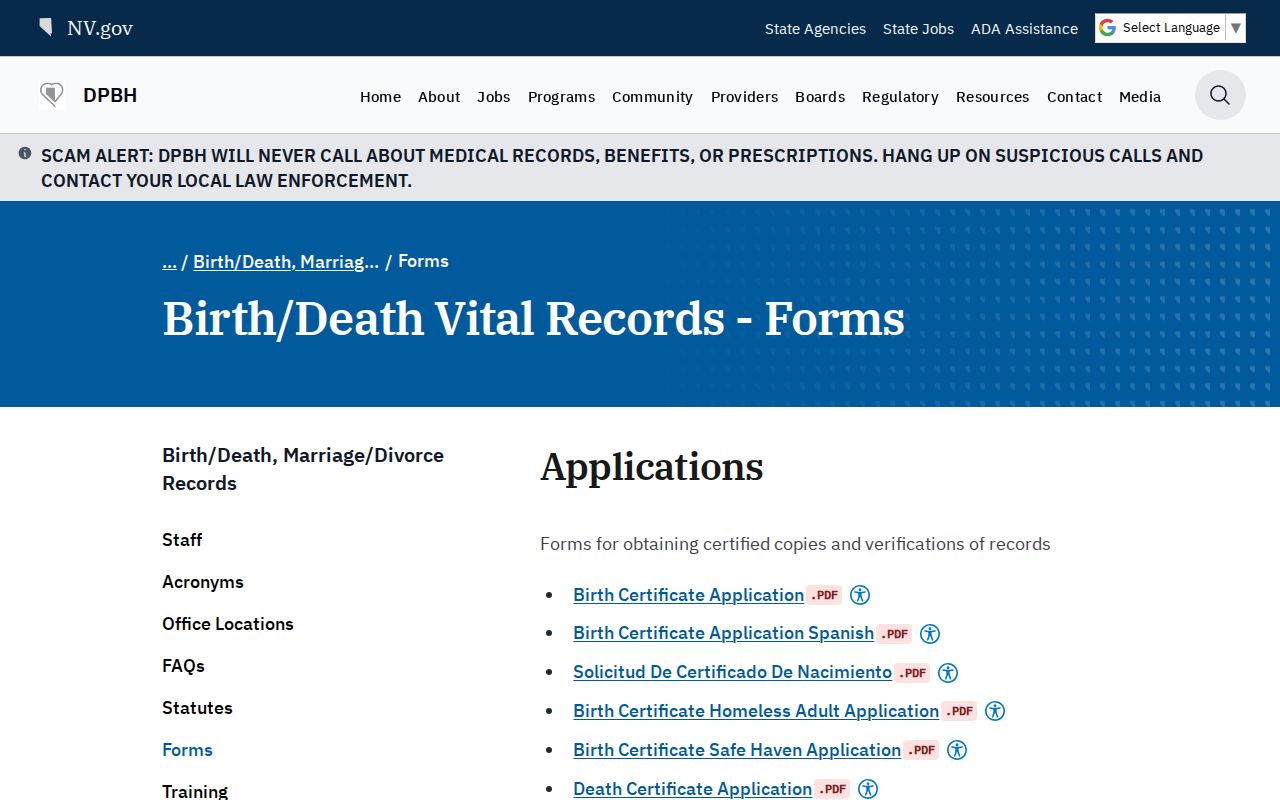
The forms reinforce the key boundary: a public records request does not replace the certificate application or its eligibility review. A Clark County death certificate costs $25. If the county or date of a marriage or divorce is unknown, the state offers a $10-per-name verification search, but the correct county office must still issue the actual record.
Clark County Custody and Business Records
Custody databases also have firm boundaries. The Clark County Detention Center reports current county jail custody. The Nevada Department of Corrections search covers sentenced state prison custody and warns that its web data are not an official law-enforcement record. A missing name in one system does not prove the person is absent from the other. Police and accident reports go to the agency that responded, such as Las Vegas Metropolitan Police or a city department, with victim, juvenile, and investigative details subject to redaction.
Business identity records belong to the Nevada Secretary of State. The SilverFlume entity-name search can connect a legal entity to its status, formation date, registered agent, filed managers or officers, addresses, and filing history.
The statewide entity result does not replace a Clark County fictitious-firm-name entry or the local license for the place where a business operates. Casino brand, operator, landowner, and registered entity can all differ, so each record should be treated as evidence of one role.
Clark County Public Records Offices
Choose the office by the record, not merely by a Las Vegas postal address. The Recorder handles authorized land instruments. The District Court Clerk controls its case files. Clark County’s central request portal routes departmental administrative records, but a specialized office form may ask for better fields and may carry its own fee statute.
Clark County Recorder
Attention Records Request
Box 551510
Las Vegas, NV 89155-1510
Records Search and copy orders
District Court Clerk
200 Lewis Avenue, third floor
Las Vegas, NV
(702) 455-2590
Monday through Friday, 9 a.m. to 4 p.m.
Family Court Clerk
601 North Pecos Road, first floor
Las Vegas, NV
(702) 455-2590
Monday through Friday, 9 a.m. to 4 p.m.
Note: For city permits, licenses, police reports, or municipal cases, use the incorporated city’s custodian instead of the county portal.
Request Clark County Public Records
A narrow request is faster to route and easier to price. First search the relevant index for a case number, instrument number, APN, license number, or date. Then ask the custodian for an existing file, not an investigation. Specify inspection, electronic delivery, a plain copy, or certification. Request an estimate before any extraordinary staff or technology work begins.
- Identify the office that created or keeps the record. Use GIS jurisdiction data when an address may fall outside an incorporated city.
- Search the office index and collect names, roles, dates, and record numbers. These details help staff locate one existing file.
- Submit the office form or a clear oral or written request. Include a focused date range and preferred delivery format.
- Review any fee estimate. Narrow the scope if broad retrieval, redaction, or system work would cause an extraordinary charge.
- If access is denied, ask for the exact confidentiality statute and for all segregable, redacted public portions.
The Clark County records-request portal displays the login and county fee notice used for many departmental requests.
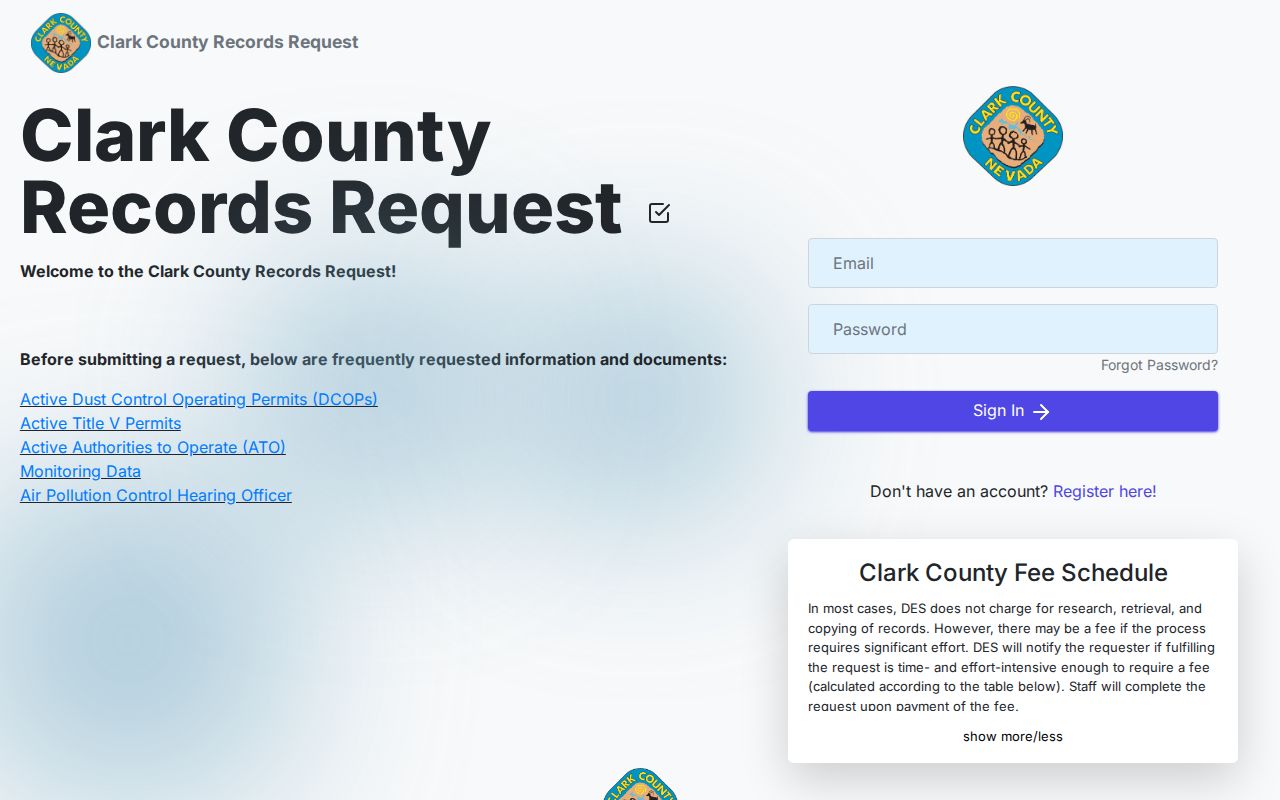
The portal is a route into the county process, not a substitute for a court, Recorder, Clerk, or vital-certificate application. If an agency denies access or delays without a valid response, NRS 239.011 permits a district-court petition in the county where the record is held.
Lawful personal use. Use open records for legitimate research, civic review, family history, estate work, or fraud checks. Never use an address or protected detail to stalk, threaten, harass, or harm anyone.